
Meta-Agent
 Click to expand
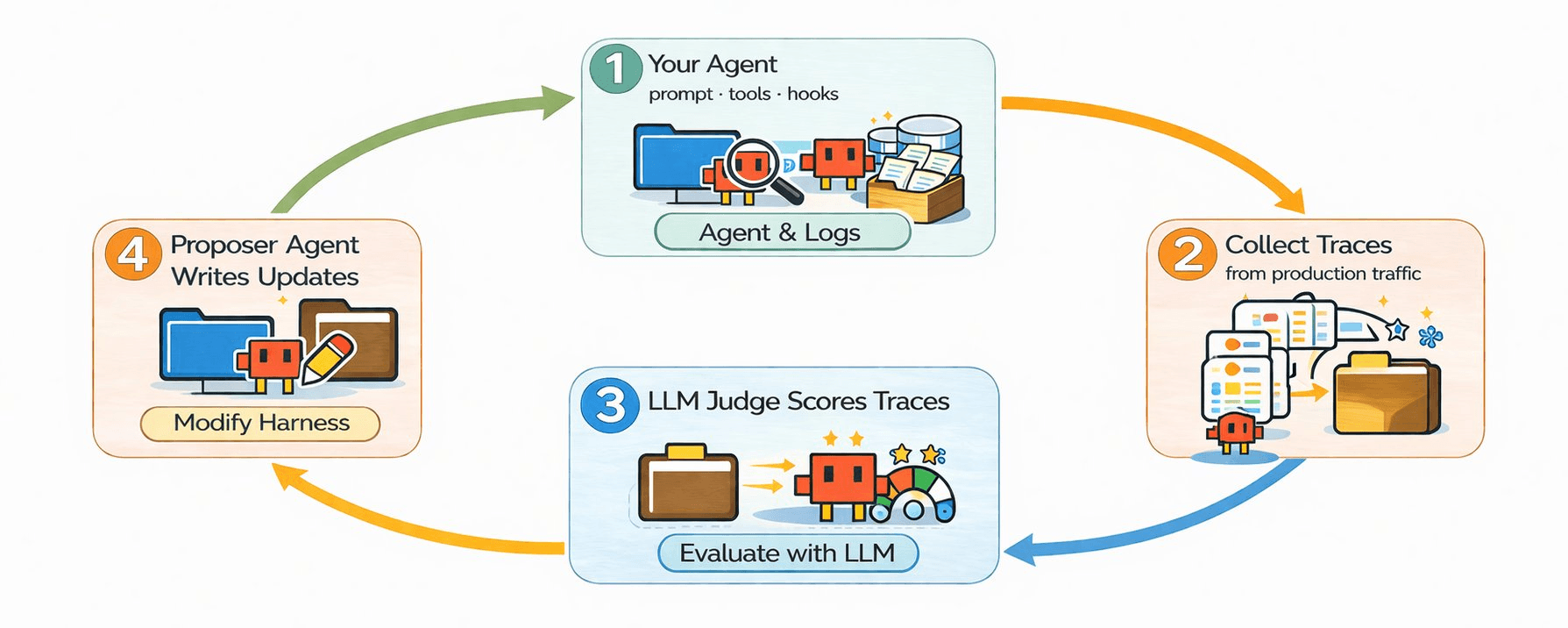
We built meta-agent: an open-source library that automatically and continuously improves agent harnesses from production traces.
Point it at an existing agent, a stream of unlabeled production traces, and a small labeled holdout set.
- An LLM judge scores unlabeled production traces as they stream.
- A proposer reads failed traces and writes one targeted harness update at a time, such as changes to prompts, hooks, tools, or subagents.
- The update is kept only if it improves holdout accuracy.
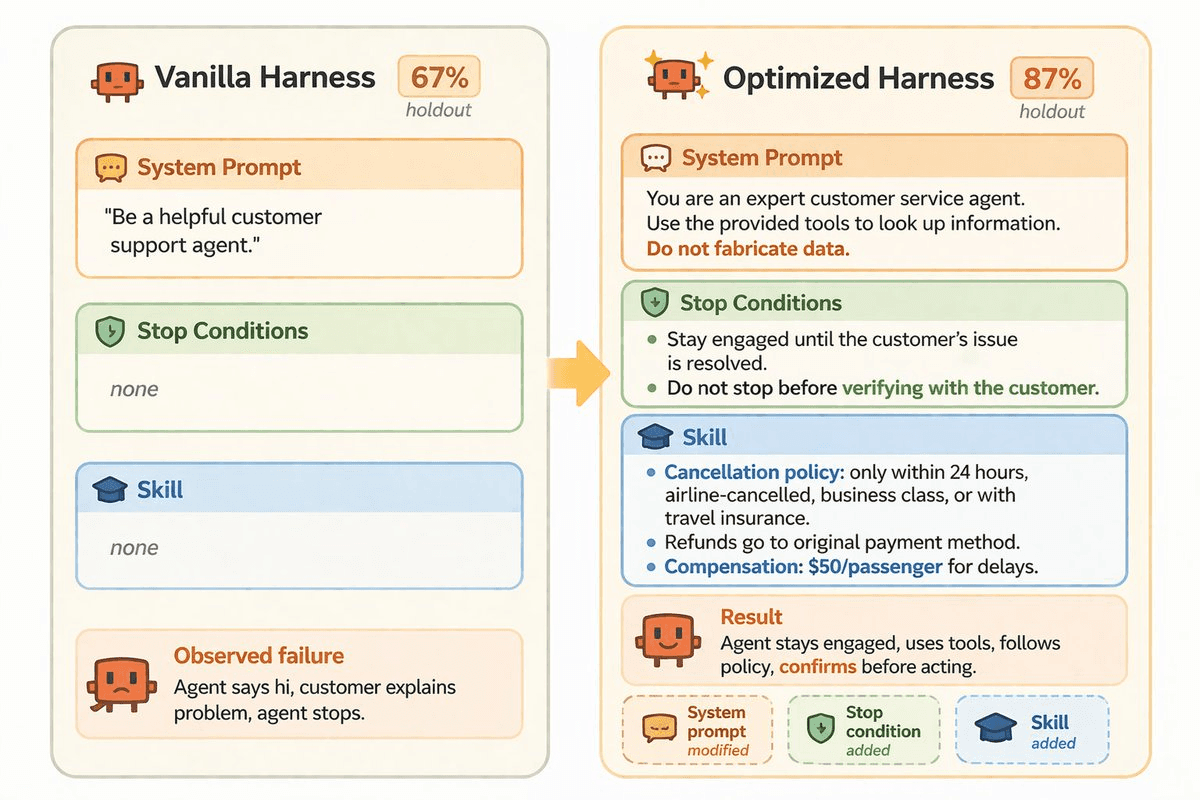
On tau-bench v3 airline, meta-agent improved holdout accuracy from 67% to 87%.
We open-sourced meta-agent. It currently supports Claude Agent SDK, with more frameworks coming soon. Try it here: github.com/canvas-org/meta-agent.
 Click to expand
Why
Recent work shows that optimizing the harness layer can materially improve agent performance.
On TerminalBench-2, vanilla Claude Code with Claude Haiku 4.5 scores 27.5%. The best hand-engineered harness on the same model reaches 35.5%, with no fine-tuning (Meta-Harness, Lee et al. 2026).
Recent systems have also shown that harnesses can be improved automatically through iterative search (Autoresearch, Karpathy 2026; Meta-Harness, Lee et al. 2026). But those methods usually depend on strong evaluation signals during search, such as labels, tests, or deterministic checks. Agents typically run on messy customer workflows where labeled reward is sparse or unavailable.
meta-agent is built for exactly that production setting: it reads traces from the running agent, uses an LLM judge to score them, and proposes harness updates from the failure patterns it finds.
How it works
You provide an existing agent, a stream of unlabeled production traces, and a small labeled holdout set.
- Read. Collect traces from the running agent.
- Judge. Score those traces with an LLM judge.
- Propose. Read failed traces, identify a recurring failure pattern, and write one targeted harness update.
- Validate. Evaluate the new harness on the holdout set and keep it only if holdout accuracy improves.
- Repeat. Continue the loop with the updated harness.
Filesystem memory. meta-agent stores each harness candidate, its scores, and its traces on disk. This gives the proposer persistent memory across iterations. Before proposing a change, it can search prior candidates, per-task traces, and scores to see what failed, what has already been tried, and which changes actually improved performance.
What the optimizer can change
The optimizer can modify the parts of the harness that most directly shape agent behavior:
- the system prompt
- lifecycle hooks for tool use
- stop conditions and error handling
- custom tools, permission logic, and subagents
- other control logic around the model
It makes one targeted change at a time and prefers the smallest effective fix.
Results
Tau-bench v3 is a benchmark for conversational customer service agents. We evaluate on the airline domain (50 tasks), where the agent must follow policy and resolve customer requests.
Setup: We split the 50 airline tasks into 35 for search and 15 for holdout. The agent used Haiku 4.5, the proposer used Opus 4.6, and holdout was always graded with the official tau evaluator.
Starting from a 67% baseline, the judge-based search run reached 87% holdout accuracy. In our current setup, this was higher than the 80% reached by our labeled-search variant.
| Method | Search signal | Holdout accuracy |
|---|---|---|
| Vanilla harness | None | 67% |
| meta-agent, labeled search | Gold labels | 80% |
| meta-agent, LLM-judge search | LLM judge | 87% |
For LLM-judge search, we replaced gold labels on the search split with an LLM judge that reads each trace and produces a short critique of the agent's failure. The proposer sees natural-language error descriptions, such as “the agent refunded without checking the cancellation policy.” This may provide a richer optimization signal than binary supervision alone, and could help explain why the judge-based run potentially outperformed our labeled-search variant in this setup.
Note: These are single-run results on a small benchmark split. We plan to expand the evaluation with multiple runs and variance estimates in future work.
Harness evolution
The harness did not improve in one shot. The proposer iterated through multiple attempts, learning from failure traces at each step. The table below shows the progression for our best-performing run (Critique, 87% holdout).
| Epoch | What the proposer tried | Holdout | What happened |
|---|---|---|---|
| 0 | Vanilla config | 67% | Agent quits after one greeting |
| 1 | Modified the system prompt + added a stop condition | 53% | Agent stays engaged but makes up answers instead of looking things up |
| 2 | Rewrote the system prompt with tool-use rules | 47% | Agent uses tools now but too many instructions confused it |
| 3 | Supplemented the system prompt with a skill (domain knowledge) | 80% | Agent already knew how to use tools, it just needed the right policy |
| 4 | Expanded the skill with additional policy rules | 73% | New rules were too narrow and didn't generalize to holdout |
| 5 | Fixed the skill (proposer caught its own factual errors) | 87% | Agent was following instructions correctly but the instructions were wrong |
Starting from a vanilla harness, the proposer first added a stop condition to keep the agent from quitting early, but this reduced holdout because the agent stayed engaged while hallucinating answers. It then rewrote the system prompt with tool-use rules, which encouraged tool use but added too much prompt overhead.
The key improvement came when the proposer moved business rules into a skill, raising holdout to 80%. In the final step, it corrected factual errors in that skill, reaching 87%.
The full improvement came from just three harness components: a stop condition, a rewritten system prompt, and a skill containing domain rules.
What we learned
Judge-based search is viable on unlabeled traces. We use an LLM judge to score unlabeled search traces during optimization, while keeping a small labeled holdout set to decide whether to keep an update. In our current setup, this reached 87% holdout accuracy, compared with 80% for our labeled-search variant.
Persistent trace memory helps. Giving the proposer access to prior harnesses, traces, and scores helped it avoid repeating failed changes and even catch errors in its own earlier policy rules.
Proposer tends to overfit. Early iterations often fixed the specific traces the proposer saw rather than writing general behavioral rules, which improved search accuracy while hurting holdout. We reduced this by adding a simple instruction:
“State your change as a rule about agent behavior. If you can only justify it by pointing to specific traces, it's too narrow.”
The proposer prompt matters. Small changes to the proposer's instructions had a large effect on optimization quality.
Improving the LLM judge
The strongest Meta-Agent run used an LLM judge to diagnose failures in unlabeled traces. That exposed a second problem: Meta-Agent could only correct failures the judge recognized and described accurately.
We explored this in a separate experiment, Meta-Reward. Starting with a small set of trusted trajectory preferences, we optimized the evaluator so its scores better matched those preferences. The Haiku 4.5 judge weights remained fixed. Instead, a proposer revised the procedure the judge followed: the evidence and policy context it received, the checks and rubric it applied, and how it converted its judgment into a score. Candidate procedures were evaluated on held-out preference pairs.
trajectory

LLM judge
score
On τ³-bench airline, held-out agreement improved from 52.8% to 78.2%. In a small, single-run downstream stress test, using the resulting reward to guide agent-harness search improved official task success from 60% to 80%.
Try it today
Download meta-agent and get started today. github.com/canvas-org/meta-agent
Point it at your agent, a task set, and a labeled holdout split. In our experiments, the optimizer found its best harness within 4–10 iterations. You get a ranked set of harnesses with per-task traces explaining what changed and why. Let us know what you think!
What's next
More frameworks. meta-agent currently supports Claude Agent SDK. We plan to add support for Codex SDK, OpenCode SDK, and other agent frameworks.
Better proposer optimization. The proposer has strong leverage on final harness quality. We want to explore a meta-loop that improves the proposer's own instructions over time, including better failure abstraction and clustering.
More benchmarks. We plan to evaluate on broader agent benchmarks, including SWE-bench, TerminalBench-2, and domain-specific customer service tasks.